Episode Summary
What happens when three consultants write three different specification sections for the same material, and no one discovers the overlap until publication day?
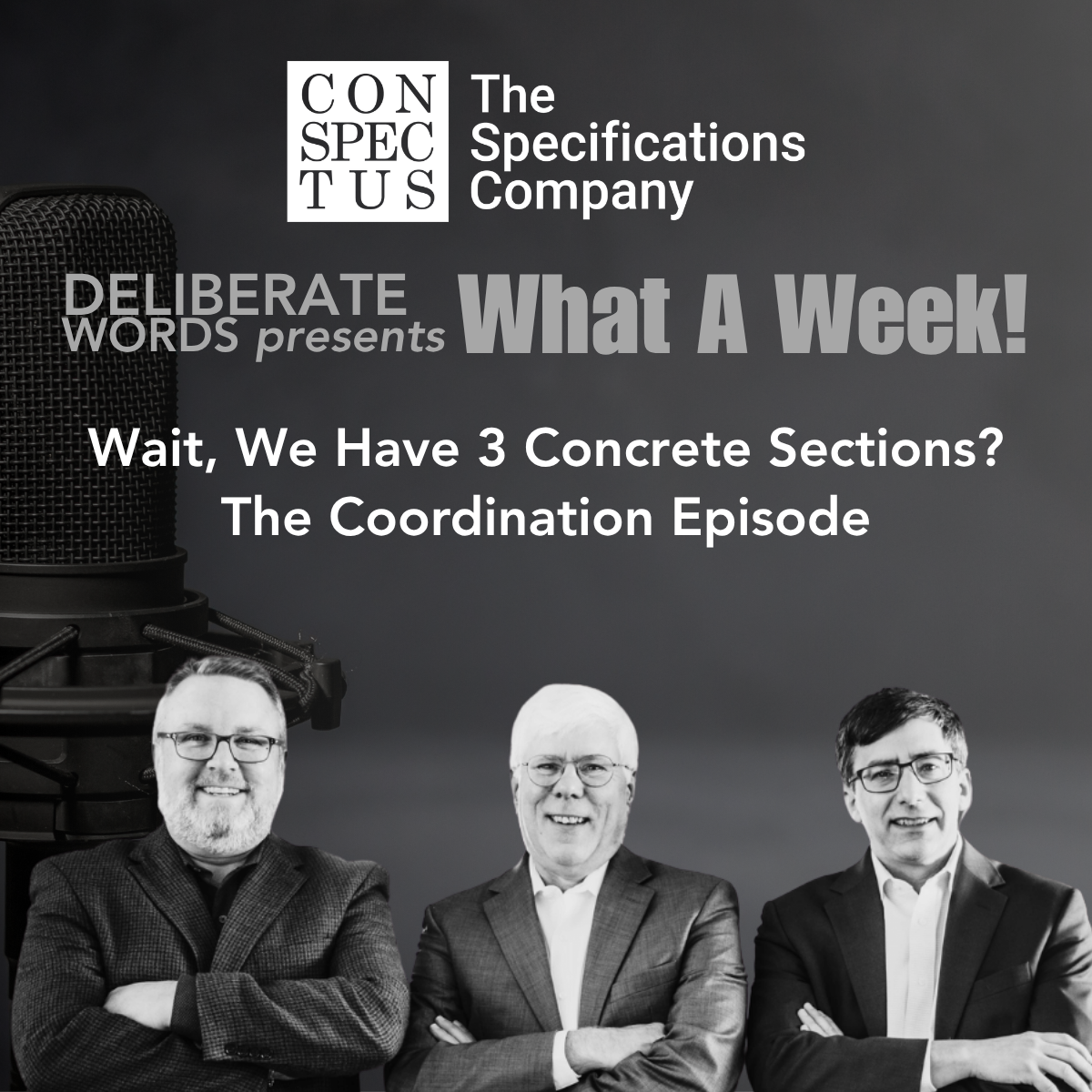
In this episode of What a Week, Dave Stutzman, Steve Gantner, and Elias Saltz tackle a common construction documentation challenge: coordination across disciplines. Using cast-in-place concrete as an example, they explore how structural, civil, and landscape consultants can develop overlapping specifications, creating duplicate sections, conflicting requirements, and uncertainty about responsibility.
The discussion examines the risks of last-minute renumbering, combining sections, and relying on drawing references that may change. More importantly, it highlights why specification coordination must begin early and continue throughout design, starting with shared tables of contents, clearly defined scopes, and ongoing communication among consultants.
The takeaway is simple: Coordination isn't something you fix at the deadline. It's a process that needs to be built into the project from the beginning. Better planning and information sharing can prevent document conflicts, reduce last-minute revisions, and produce a more cohesive set of construction documents.
Learning Points
Industry Insight: Coordination challenges often arise when multiple consultants develop specifications for the same material or system. Without clearly defined responsibilities, duplicate sections and conflicting requirements can create confusion during bidding and construction.
Practice Takeaway: Renumbering or retitling duplicate specification sections may resolve an immediate conflict but can introduce new problems with cross-references, drawing notes, and scope assignments. Coordination must address the content, not just the section numbers.
Process Lesson: Start coordination early with preliminary specification tables of contents and proposed drawing lists. Sharing these documents throughout design helps identify overlapping scopes, missing information, and potential conflicts before publication.
Collaboration: Architects, engineers, landscape architects, and specifiers need to establish who is responsible for each requirement. Regular communication and shared document development can help produce a coordinated set of construction documents.
Risk & Opportunity: Last-minute coordination increases the likelihood of errors, omissions, and inconsistent requirements. A continuous coordination process allows teams to resolve questions while there is still time to make informed decisions.
Key Takeaway: Effective coordination isn't a final quality-control exercise. It's an ongoing responsibility that begins at the earliest stages of design.
All we really need to know is the table of contents. And we can start the conversation.

 Elias Saltz, Steve Gantner, David Stutzman